Wine reviews

Wine Review: Arthur Metz 1904 Crémant d’Alsace NV at SuperValu

SuperValu’s 2024 French Wine Sale runs from Thursday 5th to Wednesday 25th September. Among the wide arrange of wines on offer there are three wines from Alsace, including a Riesling and a Pinot Blanc from Marcel Hugg which I have yet to try. The star for me, though, is this Crémant d’Alsace from Arthur Metz.

Arthur Metz is one of the largest wine groups in Alsace and is widely available within the country – I’ve picked up many a bottle from the local supermarket when I’ve been holidaying in France. Like most negotiants, the focus is on value and variety, but there are occasional gems to be found among the stalwarts.

Crémant is a traditional method sparkling wine which accounts for close to a quarter of all wine produced in Alsace. It’s so popular in France that it takes second place in domestic sparkling wine sales behind the behemoth that is Champagne.

Ageing requirements for Crémant are more modest that those for Champagne but this 1904 Cuvée has a full 24 months ageing. The main variety is Pinot Blanc but there are also contributions from Auxerrois, Chardonnay, Pinot Gris and Pinot Noir (vinified white, or course).

Being a fully sparkling wine (no “frizzante” nonsense here) this has a proper cork and cage, and has a lovely, lively mousse after pouring. The nose has lemon sherbert and apple pie notes, from the grapes and the lees ageing respectively.

On the palate there’s an initial flavour of soft pear and apple, followed by fresh citrus, and finally juicy apricots. To get such a range of flavours in a modestly priced fizz is almost unheard of. Complexity!

The final proof of the pudding was the quarter glass that I came back to later in the evening after domestic duties had demanded my attention. Even close to room temperature and with much of the mousse having evaporated, this 1904 Cuvée still tasted great: the true sign of a great sparkler. Balance!

  • ABV: 12.0%
  • RS: Brut
  • RRP: €25 down to €20
  • Source: sample
  • Stockists: SuperValu stores

Wine reviews

Wine Review: Marc Kreydenweiss Alsace Grand Cru Moenchberg Pinot Gris 1997

Domaine Marc Kreydenweiss

The Kreydenweiss family can trace their roots in Andlau’s vines back to the 18th century where their forebears the Gresser family grew grapes and also ran a mill on behalf of the Abbey. In 1850 Alfred Gresser began bottling his own wines, quite novel at the time. His son Fernand decided to sell off the family’s mill in 1918 and concentrate on the wine business. At the end of WWII it was Denise’s turn to take the reins, along with her husband René Kreydenweiss. This couple transitioned the family business from wholesale to selling to the general public.

1971 saw the torch passing to Denise and Réné’s son Marc Kreydenweiss. A geology-obsessed visionary, he pushed the wines towards a pure expression of their terroir. This was enhanced by an evolution into biodynamic viticulture – he became founding president of the Biodyvin organisation in 1989.

The eldest of Marc’s six children, Manfred, had joined Marc in the ’80s and was part of the move to biodynamics, but he sadly died in an accident at the age of 37 in 2008. The other sons were already involved in the family business; Antoine in Alsace and Jean in the family’s newer venture in Costières de Nîmes. Marc moved permanently to Nîmes giving Antoine free range in Alsace.

Antoine began a number of projects to improve the Domaine and its wines. He let certain wines mature on their lees for longer, and introduced a horse “Sam” for tilling between the rows of vines. After a decade of falling yields, in 2016 he decided to start buying grapes from six local vignerons who were either organic and / or biodynamic and had great sites. This also enabled him to start producing Crémant d’Alsace.

Since then change has been the norm; a new cellar of 650 m² over 2 levels, more stainless steel tanks, concrete eggs and large format barrels, a stable and more horses, and more partner growers.

Grand Cru Moenchberg

Grand Cru Moenchberg extends over two villages, Andlau and Eichhoffen. The name Moenchberg – literally “Monk’s Hill” – dates back to the 11th century, though the area had already been under vine for four centuries at that point. The name reflected the influence of the clergy in winemaking, just as in Burgundy, and in particular the Benedictine monks of Altorf Abbey. Documents show that Alsace Pope Leo IX ordered wine from the Andlau area.

The soils are Marl-limestone-slate and colluvium material (loose sediments at the base of a steep slope, cf alluvium whch is generally washed down by water) and range between 230 to 260 metres. Exposure is to the South and South-East and the total area is 11.83 hectares. The predominant variety planted is Riesling (62%) with Pinot Gris (23%) and Gewurztraminer (15%) making up the balance.

The limestone soil lends Moenchberg wines an expressive streak of acidity, whereas the southern aspect results in early-ripening grapes with intense fruitiness, even tropical notes. Despite their early approachability, Moenchberg wines are at their most complex after four or five years.

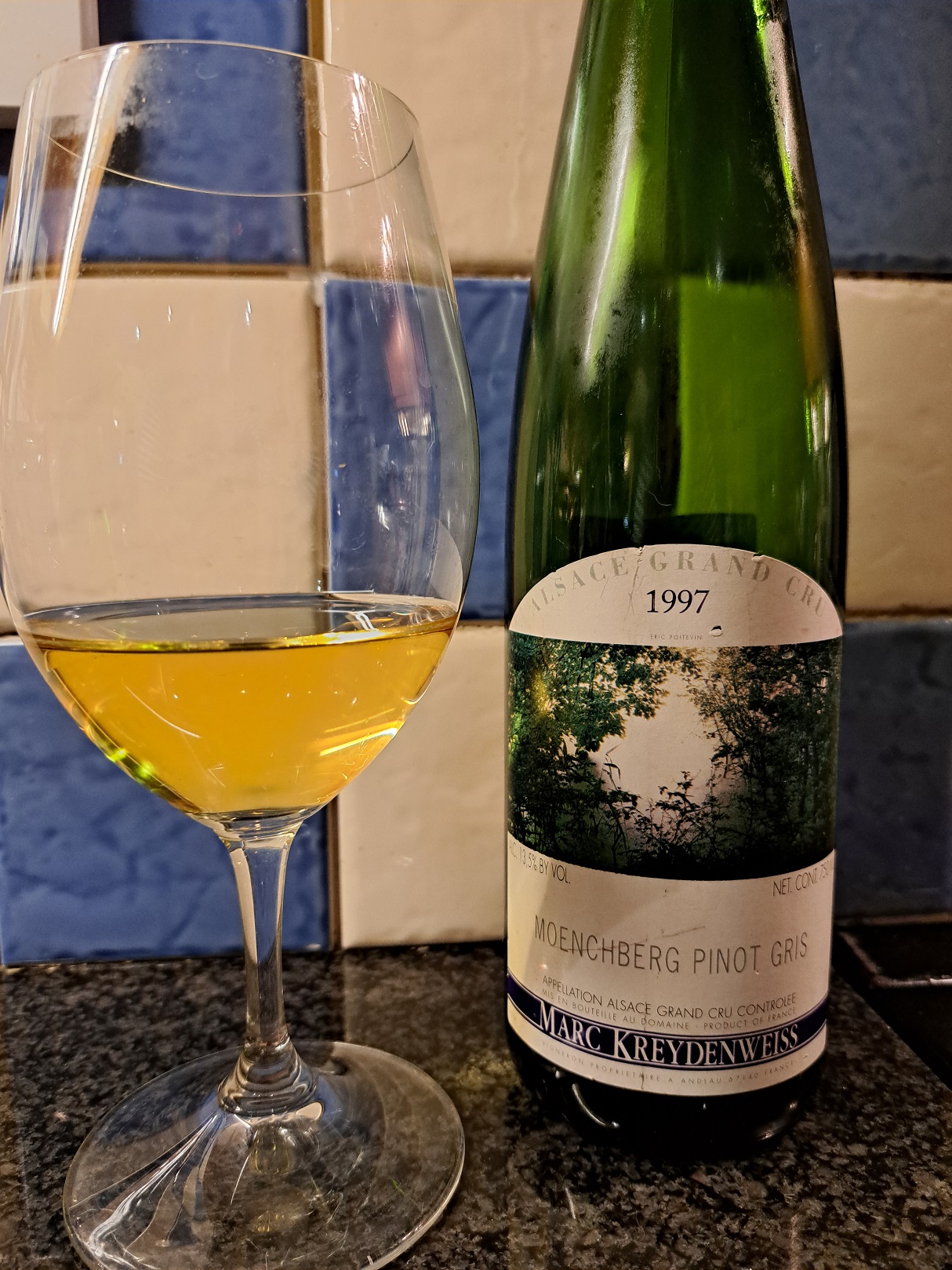
Marc Kreydenweiss Alsace Grand Cru Moenchberg Pinot Gris 1997

Marc Kreydenweiss Alsace Grand Cru Moenchberg Pinot Gris 1997 - bottle & glass

Looking back through the winery’s recent history shows that this wine was made by Marc and Manfred after their move to biodynamic viticulture. As you can see on the image above, the colour is a vibrant gold, the result of age and some residual sugar.

The nose shows honey, exotic spices, and confected pip, stone and tropical fruits. On the palate, Moenchberg’s trademark acidity has softened over the years, and is now not all all obvious, but it’s still there providing a supporting role to the fruits and tertiary notes. Quince jelly and mango sit above stewed apricot and yellow plums

I’m sure this wine will have been lovely when it was young, but it was well worth the wait. It’s one of the best wines I’ve tasted so far this year.

  • ABV: 13.5%
  • RRP: n/a
  • Source: Terroirs, Donnybrook
  • Stockists: out of stock
Wine reviews

Wine Review: Blue Tie by Pfaff

The SuperValu French Wine Sale is upon us again, joined this year by some German wines from the Pfalz, so what better wine to start my reviews with than one from a French region on the border with Germany, an Alsace blend!

The Cave de Pfaffenheim is a co-operative with around 150 grower-members. It was founded in 1957 in the village of Pfaffenheim, around 15 km south-by-southwest of Colmar. The microclimate there is a little greener than other parts of Alsace which helps the vines in dry years. The Cave itself has very modern facilities with an (as far as possible) oxygen-free environment. I tasted through their standard range at the Big Alsace Tasting a few years ago and was very impressed by their clean, fruit-forward nature.

The “Tie” range began in 2005 when the winemaker was holding a tasting / blending session with the buyer from a big French supermarket chain (I’m guessing Carrefour) and they were searching for a new brand name. Seeing someone wearing a black bow tie, they agreed on Black Tie for the first wine, a blend of Riesling and Pinot Gris. White Tie, Pink Tie and Blue Tie wines followed.

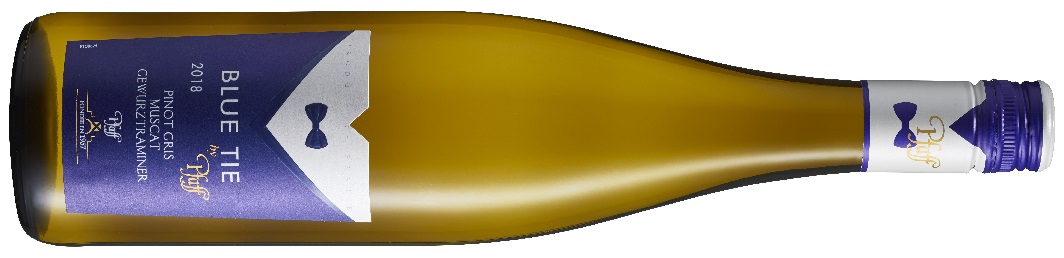
Blue Tie by Pfaff 2018

Blue Tie by Pfaff 2018

So, the Blue Tie is a blend of Pinot Gris, Muscat and Gewurztraminer. The relative proportions aren’t given, but I think it’s safe to say they are in descending order as written – due to its expressiveness, Gewurz would totally dominate other varieties if it made up a majority of a blend. The vines are situated in the lower hills of the Vosges between 200 and 400 metres above sea level, with an easterly or south easterly aspect to get the benefit of the morning sun.

The grape varieties are vinified separately and aged on fine lees for four months before blending and bottling takes place. The wine does not go through malolactic fermentation to preserve freshness and balance the residual sugar; alcohol is fairly modest at 12.5%.

In colour, Blue Tie is lemon, but that’s not where the main action is: the nose! The nose has explosive aromas of spice, lychees, roses, mango, pineapple and grapes – such a joy to sniff!

These notes continue onto the palate, but they are a little more restrained…perhaps a little crisper than the nose suggests, which is the influence of the Muscat and the acidity.

This is a great example of an Alsace blend and would be amazing with Asian cuisine or just on its own.

  • ABV: 12.5%
  • RS: 20 g/L
  • RRP: €10.00 down from €16.99 from 1st to 21st Sept 2022
  • Source: sample
  • Stockists: SuperValu stores

Look out for other articles on wines from the SuperValu French & German wine sale on Frankly Wines

Wine reviews

Wine Review: Gustave Lorentz Alsace Grand Cru Riesling

Before we get to the wine itself, with probably the longest name I’ve ever included (see below), let us first have a quick glance at the Alsace Grand Cru vineyard it comes from – Altenberg de Bergheim – and its producer – Gustave Lorentz.

Altenberg de Bergheim

Somewhat confusingly, three of Alsace’s fifty one Grands Crus are named “Altenberg”, but it makes more sense when you realise that the name means “Old Mountain”, and so could easily be applied to several places in Alsace. Confusion is reduced by adding the name of the commune in which the vineyard is located, hence Altenberg de Bergbieten, de Bergheim, and de Wolxheim. The first and last of these are villages in the north of Alsace, 30 to 40 km due west of Strasbourg. Bergheim is in the heart of the Alsace vignoble, just north of Ribeauvillé, and its Altenberg has been renowned for its wines since the 12th century.

This Grand Cru totals 35.06 hectares and lies between 220 and 320 metres above sea level. The soil is a rocky, fossil-laden mix of marl and limestone from the middle and lower Jurassic period. The aspect is due south, with a small stream at the bottom of the slope which slightly tempers the microclimate. All this adds up to wines which are very concentrated and mineral, often a little closed in their youth, but which reward cellaring for five years up to several decades. Riesling and Gewurztraminer are the stars here.

Gustave Lorentz

The Lorentz family count three dates as important milestones for their winery: 1650, when the first ancestor moved to Alsace, 1748 when the family moved to Bergeim, and 1836 when they began producing their own wine.

Their Réserve range is popular in Ireland and widely available. I’ve enjoyed several vintages of their Réserve Riesling and Réserve Pinot Blanc, plus their L’Ami des Crustacés blend is well worth a try. Their full range is summarised in the appendix to my review of their Pinot Blanc mentioned above, but the jewel in the Lorentz crown is undoubtedly their holdings in Altenberg de Bergheim, planted to Riesling and Gewurz. In fact, with 12.77 hectares they account for just over a third of the whole Grand Cru.

Gustave Lorentz Grand Cru Altenberg de Bergheim Riesling Vieilles Vignes 2017

Gustave Lorentz Grand Cru Altenberg de Bergheim Riesling Vieilles Vignes 2

Not only is this a Grand Cru wine, but it also has the designation Vieilles Vignes, or “Old Vines”. All the vines whose grapes went into this wine were over 30 years old, with a few even approaching 50. This is said to give increased concentration of aromas and flavours, so let’s put this theory to the test.

In the glass it pours a vibrant, deep lemon which is already turning to a light gold. The nose shows minerals, lime and lemon, with just a hint of richer fruits. Scientists say that there is no known mechanism for minerals to actually be absorbed by vines, and make their way to the flavours of a grape, yet here we have stark evidence that minerality can even be prominent among a wine’s aromas.

This is a concentrated, dry, fresh wine. On the palate there’s lots of texture and an underlying richness, without any exhuberance. Whereas lighter Alsace Rieslings would be paired with shellfish, white fish and the like, this Alternberg has the power and concentration to cope with richer foods; Gustave Lorentz recommend matching it with all manner of foods, from goat’s cheese, to lobster, to fois gras or even plum tart – truly a versatile wine.

At five years old this 2017 has just entered its recommend drinking window, so now is the time to start supping, but I think this has decades left it in and hasn’t got close to its peak yet.

  • ABV: 13.9% (labelled at 13.5%)
  • RS: 4.45 g/L
  • RRP: €43 – €44
  • Source: sample
  • Stockists: Bradley’s Food Market, Cork; Barnhill Stores, Dalkey; Morton’s of Galway; Carry Out, Killarney
Wine reviews

Wine Review: Kuentz-Bas Alsace MosaïK Riesling

Kuentz-Bas

Like many double barrelled producers in Alsace, Kuentz-Bas was formed by the marriage of two winemaking families – Kuentz and Bas – in 1895. The Kuentz family trace their wine heritage back a whole century earlier so it is the year 1795 which appears on labels.

A big change came in 2004 when the family sold their firm to fellow winemaker Jean-Baptiste Adam. Adam himself is the 14th generation of vignerons in his family and is passionate about the local terroir. He has introduced organic, biodynamic and natural methodologies across the estate. The vineyards total ten hectares in area, including plots with the Grands Crus of Eichberg, Geisberg and Pfersigberg, around the village of Husseren-les-Châteaux, just west of Eguisheim.

The Châteaux referenced in the village name are the ruins of three ruined castles – Dagsbourg, Wahlenbourg and Weckmund – within close promixity of each other, and known locally as Les Trois Châteaux. They also give their name to the senior range in Kuentz-Bas’s portfolio which includes Lieux Dits and Grands Crus. The more modest wine range is La 4ème Tour, “The Fourth Tower”, which includes the MosaïK Riesling below.

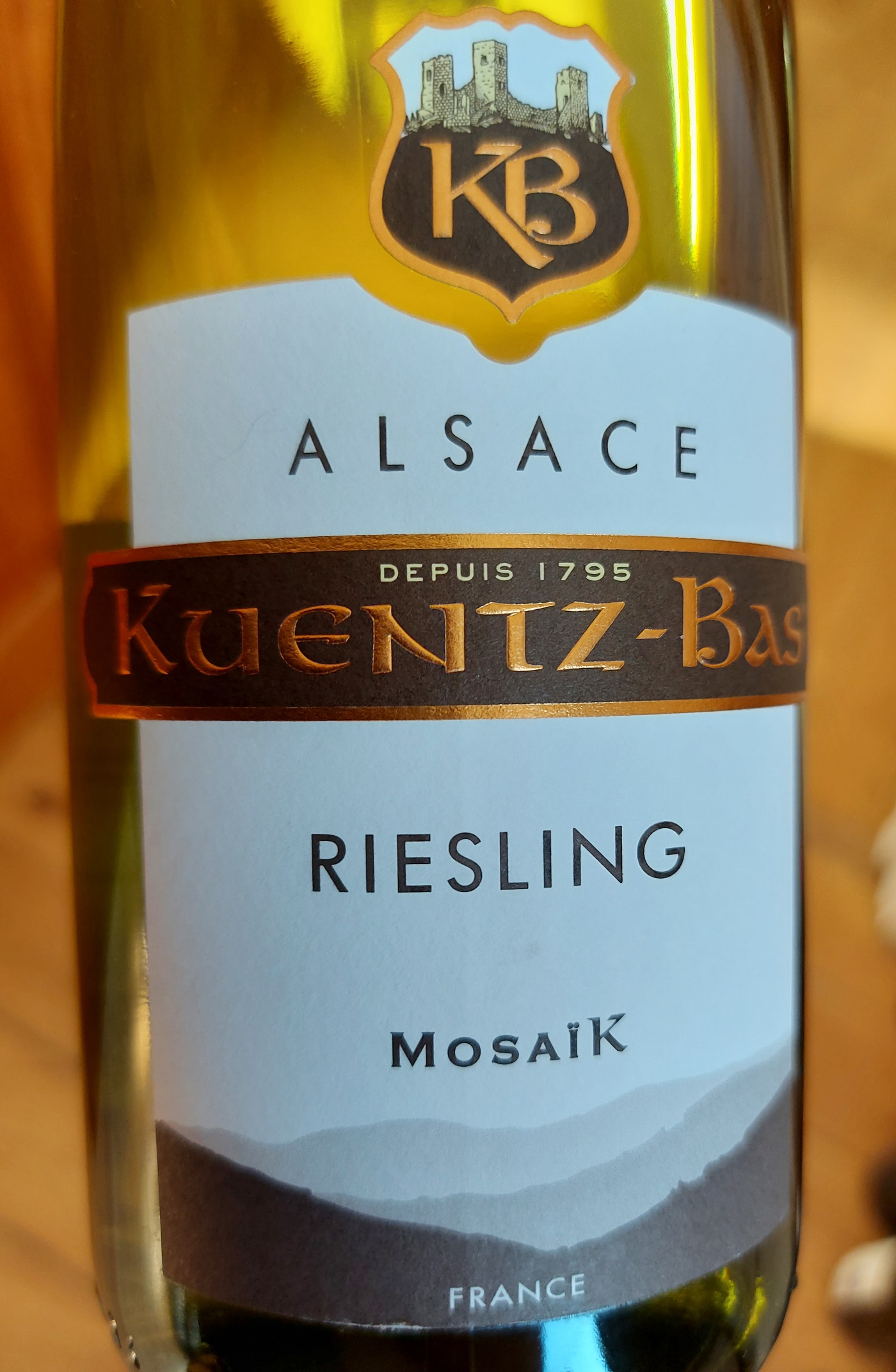
Kuentz-Bas Alsace Riesling MosaïK 2018

Kuentz-Bas Riesling Mosaik 2

MosaïK refers to the multitude of soil types that criss-cross the Alsatian vignoble (13 in total) and specifically the four on which the vines for this wine are grown: marl, clay, limestone and loess. The wine is therefore a Riesling blend.

And it’s unmistakeably a Riesling – pale in the glass then a nose of lemon and lime, golden delicious apples and hints of bitter almonds. It smells like a natural wine – precisely what that smell is lies beyond my vocabulary, but you know it when you smell it. As it’s a step away from the “normal” fruity flavours of young Riesling that might not suit everyone, but for me it adds an interesting extra dimension to the nose.

There’s fruit in the mid palate but the wine is super dry on the finish, which is almost – but not quite – austere. The pithy texture adds more savoury notes to the ensemble. I drank this wine on its own but I think it would shine brighter with food. It’s a great example of a different style of Alsace Riesling.

  • ABV: 13.5%
  • RRP: €16.95, down from €19.95 until 31st August 2022
  • Source: sample
  • Stockists: O’Briens stores and obrienswine.ie